
Instagram DM automation for e-commerce: turn DMs into sales
Most DM bots deflect. An agent that qualifies converts — one store turns 38% of chats into qualified leads. Here's the flow, and Meta's rules that gate it.

Your Instagram and WhatsApp DMs are a sales channel you're treating as a support queue. Someone comments "price?" on a reel or messages "is this in stock?" — that is a buyer with their hand up, and most stores answer hours later, if at all. DM automation done right closes that gap: one wedding marketplace we work with, DüğünBuketi, turns 38% of its chats into qualified leads, because the agent doesn't just reply — it qualifies the buyer and hands a warm lead to a person.
The catch is that most "DM automation" is the wrong kind. A keyword auto-DM that fires the same canned message at everyone deflects; it doesn't sell. This is the difference between a bot that talks and an agent that acts — and it's the whole reason one store's DMs drive bookings while another's just clear a notification badge.
Can DM automation actually sell, or only auto-reply?
It can sell — but only if it does two things a keyword bot can't: answer from your live catalog and qualify the buyer before a human ever steps in. A shopper sliding into your DMs wants a size, a price, availability, or a recommendation now. An agent connected to your store answers that from real stock, then asks the one or two questions that turn a browser into a lead — budget, occasion, which product line — and routes the ready-to-buy ones to your team.
That's why the framing matters. Support AI is usually sold as deflection: fewer tickets, lower cost. On social DMs the opposite frame is truer — every answered message is a chance to make a sale, not just avoid a cost. The 38% figure above isn't a support metric; it's a revenue one.
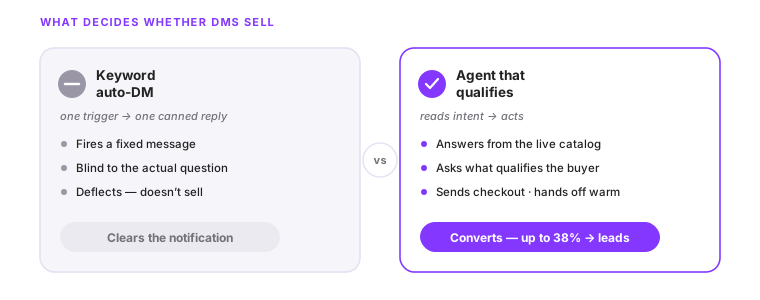
Keyword auto-DMs vs an agent that qualifies
Tools like the ManyChat-style comment-to-DM flows do one thing well: someone comments a trigger word, they get a pre-written message with a link. That's fine for a giveaway or a link-in-bio nudge. It falls apart the moment the buyer says anything the script didn't anticipate — "do you have it in 38?", "can it ship by Friday?", "what's the difference between these two?" The keyword bot has no answer, so the lead cools while it waits for a human.
An agent handles exactly those. It reads the whole message, retrieves the answer from your catalog and policies, and keeps the conversation moving toward a decision. The practical test: ask the tool "which of these two dresses is warmer?" A trigger bot can't parse it. An agent grounded in your product data can.
| The DM says… | Keyword auto-DM | Agent that qualifies |
|---|---|---|
| "price?" on a reel | Sends a fixed link | Answers the price, asks size/colour, offers the carousel |
| "is this in stock?" | Can't check — canned reply | Checks live inventory, confirms, sends checkout |
| "which one for a beach wedding?" | No match — nothing fires | Recommends from the catalog, captures the lead |
| "I need it by Friday" | Ignores it | Checks shipping, flags urgency, hands to a human if needed |
What "qualifying a lead in a DM" actually looks like
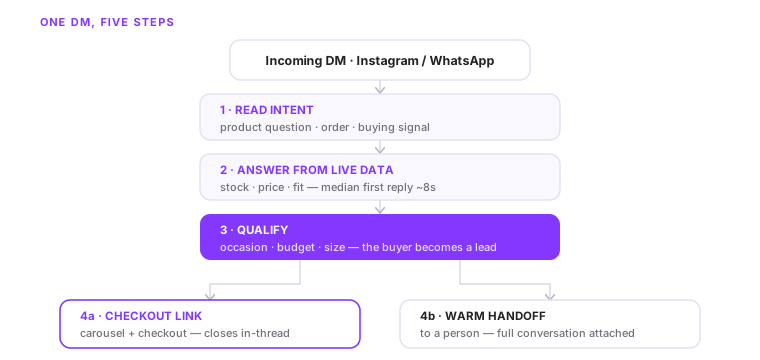
Qualifying isn't interrogation — it's the two or three questions a good salesperson asks before recommending. In a DM that runs as a short, natural sequence the buyer barely notices:
- Read intent. The agent classifies why they messaged — product question, order status, or a genuine buying signal.
- Answer from live data. Stock, price, and fit come from your real catalog, so there's no "let me check and get back to you." İnce Topuk, a fashion store, runs this on WhatsApp with a median first reply around 8 seconds.
- Ask what qualifies. Occasion, budget, size, or which line — the minimum to recommend the right product, captured with a short lead-capture form when it helps.
- Move to the sale. A product carousel from live stock, then a checkout link in the same thread.
- Hand off warm. Anything high-value, ambiguous, or ready-to-close goes to a person with the whole conversation attached — no repeating.
Because the same agent runs across channels from one unified inbox, a customer who starts in an Instagram DM and follows up on WhatsApp meets the same conversation — not a cold restart. Social DMs are one front of AI customer service for a small business, not a separate tool. And if they write in another language, Live Translate lets the agent reply in theirs while your team still reads it in yours.
Instagram and WhatsApp have rules — respect them
This is where cheap tools get stores in trouble. Automate through the official APIs — Instagram Messaging (for DMs and comment replies) and the WhatsApp Business Platform API — never an unofficial tool that drives the consumer app. The unofficial route violates Meta's terms and the failure mode is a banned number or account, usually at the worst time.
Two platform rules shape what you can send, and they're Meta's, not any vendor's:
- The messaging window. Once a customer messages you, you can reply freely for 24 hours. That covers nearly all DM sales chat, since the customer starts it.
- Opt-in for proactive messages. To message someone first outside that window — an abandoned-cart nudge, a back-in-stock alert — you need their opt-in and, on WhatsApp, an approved template. Plan for it; don't assume you can broadcast.
Where the human still wins
Automating DMs isn't about removing people — it's about spending them where they matter. A wholesale enquiry, a wedding order worth thousands, an upset repeat customer: those deserve a person, and forcing an AI answer there costs you the sale. The point of a clean handoff is that the agent clears the repetitive majority in seconds and escalates the high-value minority with context — so your team spends its time on the chats that actually convert, not on "what's my order status?"
That's also how you protect the personal feel that makes social selling work. Fast, accurate answers plus a human on the moments that count reads as better service, not automated brush-off.
What it takes to turn your DMs into a sales channel
Less than a big platform migration, more than pasting a script. Three moves:
- Connect the official channels — Instagram Messaging and the WhatsApp Business API, plus your store so the agent sees live products and orders.
- Feed it your truth — catalog, sizing, shipping and returns — so it recommends from your store, not from guesses.
- Design the qualify-and-handoff — the questions that qualify a buyer, and which chats go to a person and how fast.
The work that decides success isn't the connection; it's how well the agent is grounded and where you draw the handoff line. Get those right and your DMs stop being a queue you dread and start being the channel that reduces your ticket load and books sales.
If you want to see which of your Instagram and WhatsApp conversations an agent could qualify and close — and which should always reach a person — that mapping is where we start. See how chat becomes a sales channel for your store.
Common questions
- Can I automate Instagram and WhatsApp DMs without getting my account banned?
Yes, on the official APIs. Instagram Messaging and the WhatsApp Business Platform API allow automation and respect opt-in and messaging windows. Bans come from unofficial tools that drive the consumer app — avoid those.
- Isn't this just an auto-DM tool like ManyChat?
No. Keyword auto-DMs fire a fixed reply when someone comments a trigger word. An agent reads the whole message, answers from your live catalog, asks the one or two questions that qualify the buyer, and hands a warm lead to a person — it acts, it doesn't just reply.
- Won't automating DMs make my brand feel robotic?
Only if it can't hand off. A good agent resolves the repetitive questions in seconds and pulls a human in — with the full conversation — the moment the chat is high-value or off-script. Customers get faster answers, not a dead end.
- Can a DM conversation actually close a sale, not just answer?
Yes. It can send a product carousel from live stock, capture a lead with a short form, and drop a checkout link in the same thread — so the message that asks "do you have this in blue?" becomes an order.
- How many DMs realistically turn into leads?
It depends on your traffic and how well the agent is grounded. One wedding marketplace we work with, DüğünBuketi, turns 38% of its chats into qualified leads — but treat that as what good design makes possible, not a guarantee.
About the author

Bilgehan YılmazCo-Founder · Growth & CX
Co-founder of Vivollo and a serial entrepreneur on the growth and customer-experience side — also founder of DüğünBuketi.com and Grispi. He writes about turning support conversations into revenue.
Bilgehan Yılmaz →Keep reading
WhatsApp AI chatbot for Shopify: what actually works
What an AI agent on WhatsApp can really do for a Shopify store — live catalog answers, order lookups, and the 66% of chats real stores resolve without a human.
After-hours customer service for a small online store
Your store is open 168 hours a week; a small team covers ~50. An AI agent closes about two-thirds of overnight chats in ~8s and queues the rest for morning.
AI customer service for small business: what AI handles, what you keep
An AI agent resolves 66–72% of a small store's conversations — orders, sizes, returns — so a team of 1–5 covers the rest. What works, and how to start.