
AI customer service for small business: what AI handles, what you keep
An AI agent resolves 66–72% of a small store's conversations — orders, sizes, returns — so a team of 1–5 covers the rest. What works, and how to start.

For a small store, AI customer service isn't about replacing your team — it's about a handful of people covering the work that used to need a roomful. An AI agent takes the repetitive majority of conversations (in our deployments, 66–72% end without a human, with a median first reply around 8 seconds), so the one-to-five people you have spend their time on the cases that need a human read.
That's the promise. The rest is the part the sales demo skips: what it does, what stays with you, the three levers that decide whether it works, and how a small store starts.
What "AI customer service" means for a small store
It means an agent, not a scripted FAQ widget. The difference matters. An older chatbot matches keywords and sends anything real to a human. A modern AI agent reads your catalog and policies, looks up a live order, recommends a product, processes a return, and escalates to you only when it should — the agentic-vs-rule-based difference in practice.
For a small store that's the whole point: you don't have the staff to answer "where's my order?" two hundred times a week, and you don't want a dumb bot frustrating the customer who finally asks something specific. An agent handles both — the volume and the specifics — because it can actually do things, not just talk.
What it handles — and what stays with you
The model that works for a small store is simple: AI on the front line, you as the backup. The agent takes the repetitive, answerable, transactional majority; the judgment calls route to you, fast and with context.
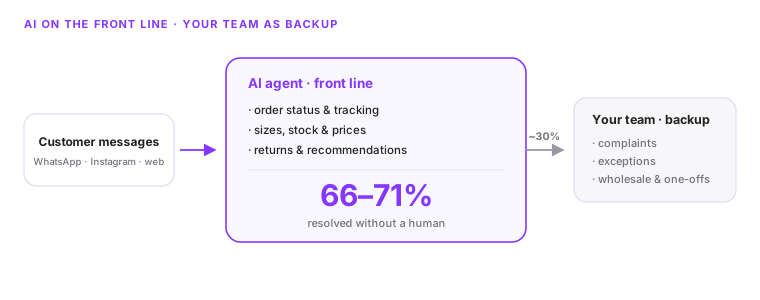
The AI front line — order status with the real tracking link, sizes, stock and prices from your live catalog, returns and address changes, product recommendations, and the long tail of policy questions answered from your own pages.
Your desk — the complaint that's really about something else, the wholesale negotiation, the one-off exception, anything that needs a human read. A good agent doesn't guess at these; it hands them to you with the full thread, so you pick up where it left off.
Get this division right and the same store that was drowning in WhatsApp messages runs calmly on a small team — like İnce Topuk, a fashion store that resolves 66% of its WhatsApp conversations this way.
The three levers that decide whether it works
The AI model is rarely the bottleneck. Three levers move your results far more than which one is under the hood:
- Can it read your truth? An agent grounded in your actual catalog, sizing, shipping and returns policy — through retrieval over your own content — answers correctly. One guessing from general training invents a return policy and gets escalated. Getting that content into a shape it can actually retrieve is a task in itself — rewriting your help center for AI.
- Can it act, not just answer? Resolution needs action: looking up the order, checking live stock, starting a return. An agent that calls real tools finishes the job; a chat-only bot caps out at the share of questions that are purely informational.
- Is the handoff designed? Counterintuitively, a clean handoff — designed, not bolted on raises your real resolution rate, because it stops the AI from forcing bad answers on the cases it shouldn't touch.
Those three are also why two stores running the same tool can land at 45% and 72%. If you want to estimate your own number before committing, audit a month of conversations the way we describe in how much support AI can resolve.
Where your customers actually are
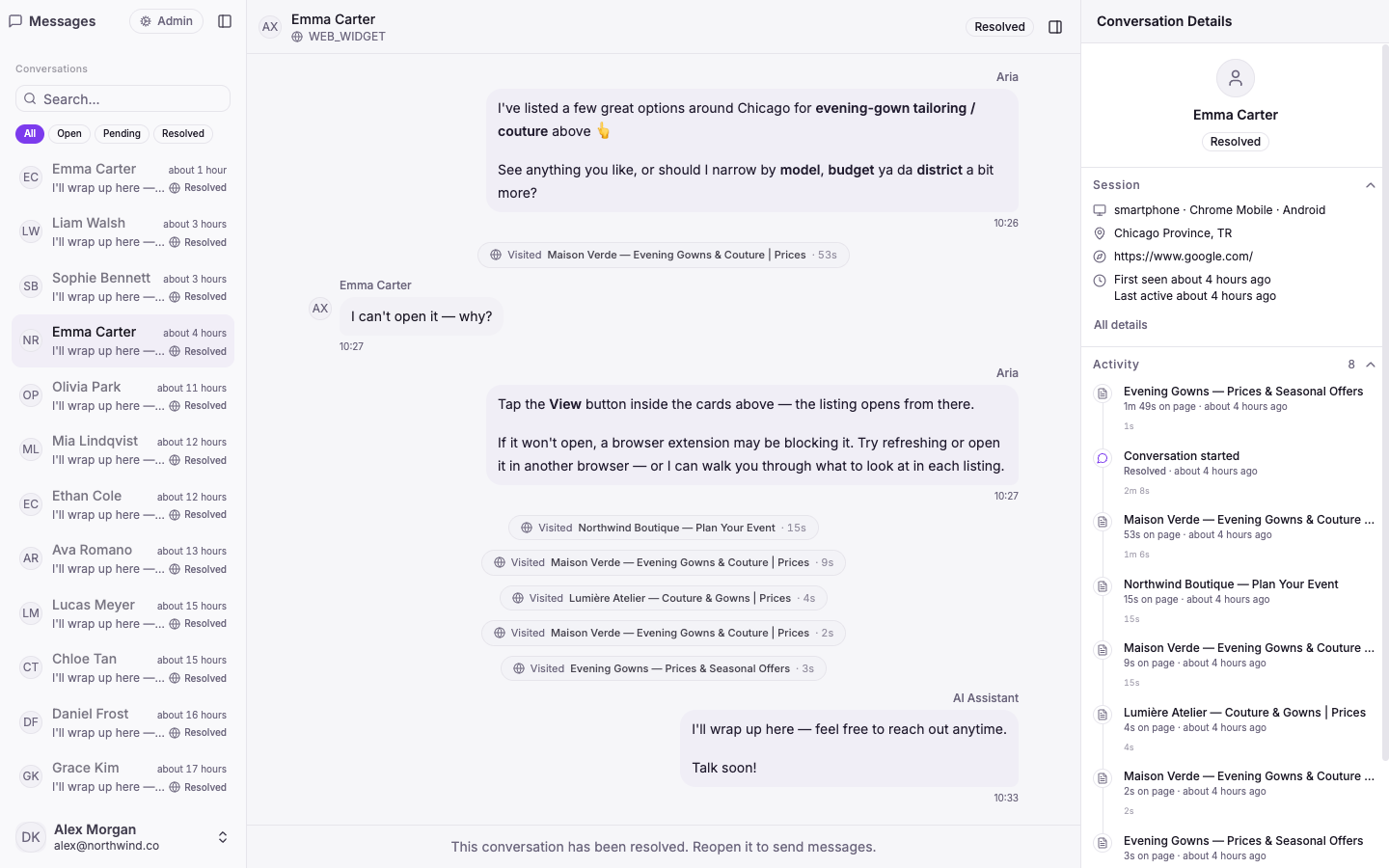
A small store's support doesn't live in a web widget nobody opens — it lives in WhatsApp and Instagram DMs, where your shoppers already are. AI customer service for a small business has to meet them there, from one inbox, so the agent carries the same context whether the customer messaged on WhatsApp today or your site last week. (Here's WhatsApp for a Shopify store or AI support on WooCommerce, end to end — and how to turn those DMs into sales.)
Those messages don't keep office hours, either — plenty of them land overnight, which is why covering the after-hours chat is where a small team often reclaims the most time.
That unified view is also what makes the AI good: it sees the whole customer, not a single isolated message — and it lets you watch what's being asked.
What it costs — without overpaying
Pricing for AI support ranges from a few dollars a month to enterprise contracts, and a small store's biggest mistake is buying from the wrong weight class. The model matters more than the headline price: per-resolution billing can surprise you as you grow, while a flat plan stays predictable — the trap we work through in detail for an Intercom Fin alternative. The full breakdown — and how to read a vendor's pricing page — is in our guide to choosing for a small business.
How a small store starts
Less than people fear. A working setup is three connections and one decision:
- Connect your store and channels — your catalog and orders (Shopify, WooCommerce) and where you talk to customers (WhatsApp, Instagram, web).
- Feed it your truth — catalog, sizing, shipping and returns policy — so it answers from your store, not from guesses.
- Design the handoff — which cases go to you, and how fast.
You can wire this yourself with a no-code builder, or have it built for you. With Vivollo's White-Glove Launch we study your store, learn from your best replies, and build and train the agent for you — typically live in days, not months.
Is it worth it for your store?
Not for everyone yet. AI customer service pays off when you have:
- Repetitive volume — the same questions, often enough that answering them by hand is a real cost.
- Knowledge that's written down (or can be) — the agent can only answer from what exists, so closing the gaps where it can't is the fastest way to raise your rate.
- Systems it can connect to — a store platform with orders and a catalog.
If your volume is tiny or every conversation is bespoke, a bot won't help yet — and a vendor who tells you otherwise is selling, not advising. For most growing e-commerce stores, though, the repetitive 60–75% — the volume you can systematically reduce — is exactly the part a small team shouldn't be spending its day on.
If that sounds like your store, the first thing worth doing isn't buying anything — it's seeing which of your conversations an agent could handle. That audit is where we start, before quoting a number, for e-commerce support.
Common questions
- Will AI customer service replace my support team?
No. It handles the repetitive majority — order status, sizes, returns, FAQs — so a team of one to five covers what used to need ten. The judgment calls, complaints and exceptions still go to a person; the AI just makes sure they reach you faster and with full context.
- How much can AI handle for a small store?
In our deployments, 66–72% of conversations end without a human — but the realistic range for most stores is 60–75%, and it depends on how much of your knowledge is written down and how many systems it can reach. See our breakdown of what drives the rate.
- Is AI customer service expensive for a small business?
It depends entirely on the pricing model, not the sticker price. Per-resolution can balloon; flat plans are predictable. Avoid enterprise tools priced for large teams — see how to choose for a small store.
- Do I need technical skills to set it up?
No. Modern tools are no-code — you connect your store and channels, point the AI at your content, and design the handoff. Some, like Vivollo, will build and train it for you, so you go live in days without writing a flow.
- Which channels does it cover?
The ones small stores sell on — WhatsApp, Instagram and your website — from one inbox, so the customer gets the same agent everywhere. See WhatsApp for a Shopify store.
About the author

Bilgehan YılmazCo-Founder · Growth & CX
Co-founder of Vivollo and a serial entrepreneur on the growth and customer-experience side — also founder of DüğünBuketi.com and Grispi. He writes about turning support conversations into revenue.
Bilgehan Yılmaz →Keep reading
Best AI customer support software for small business (2026)
An honest buyer's guide: why the resolution-rate leaderboards mislead, what to check on pricing, and how a small store should actually choose.
AI customer service for WooCommerce: what actually works
WooCommerce is self-hosted, so the win isn't the platform — it's connecting AI to your live orders and catalog. What an agent reads, writes, and resolves.
Intercom Fin alternative for small business (2026)
Fin is capable — but per-resolution pricing means you pay more as it works better. When that math turns against a small store, and what to look for instead.