
After-hours customer service for a small online store
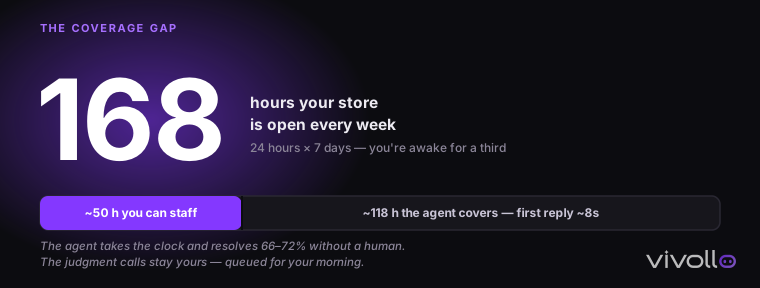
Your store is open 168 hours a week; a small team covers ~50. An AI agent closes about two-thirds of overnight chats in ~8s and queues the rest for morning.

Your store is open 168 hours a week. A committed solo operator — early starts, late evenings, one eye on the phone through Sunday lunch — honestly covers maybe 40 to 60 of them. That's not a statistic anyone can dispute; it's arithmetic. For the other hundred-plus hours, your ads keep running, your checkout keeps working, and your chat goes unanswered.
Most advice on after-hours customer service won't help with that, because it's written for a different business. Search the phrase and the results are phone-answering services: a human somewhere takes your missed calls and emails you a summary in the morning. An online store's after-hours problem doesn't ring — it types. And typing is the part an AI agent handles best: in our deployments, 66–72% of conversations resolve without a human, with a median first reply around 8 seconds — at 3 p.m. and at 3 a.m. alike.
"AI never sleeps" is the bullet point every vendor writes, and it isn't a plan. A plan is a division of labor: what the agent genuinely closes alone overnight, what queues for your morning, and how it queues. Here's that division, with real numbers attached.
What actually arrives after hours
For an online store, the after-hours queue is chat, not calls: WhatsApp messages, Instagram DMs and comments, Messenger, and your site widget. Nobody phones a boutique at 11
p.m. — but plenty of people are lying in bed with your product page open, and they write:- "Where's my order?" — from someone who ordered three days ago and remembered at midnight.
- Sizes, stock and prices — from night-time browsers one answer away from buying.
- Shipping cost and delivery time — the question standing between a full cart and a checkout.
- Returns and policy questions — the long tail your help page was supposed to absorb.
None of these are emergencies, and all of them have a short shelf life. The customer comparing your boots against a competitor's at midnight will buy from somebody before lunch; the one asking about a return decides overnight whether your store is easy or difficult to deal with. On Instagram, some of it happens in public — a question under a post reads as unanswered to everyone who scrolls past it, which is why DMs and comments are a sales surface, not just a support one.
There's a second, quieter failure: those messages land in four separate apps. An overnight question that arrives on Messenger and gets re-asked on WhatsApp the next day becomes two half-conversations nobody owns. The fix for that half of the problem is one inbox across every channel, where context follows the customer whether they wrote on your site last week or on WhatsApp tonight.
What an AI agent closes alone overnight
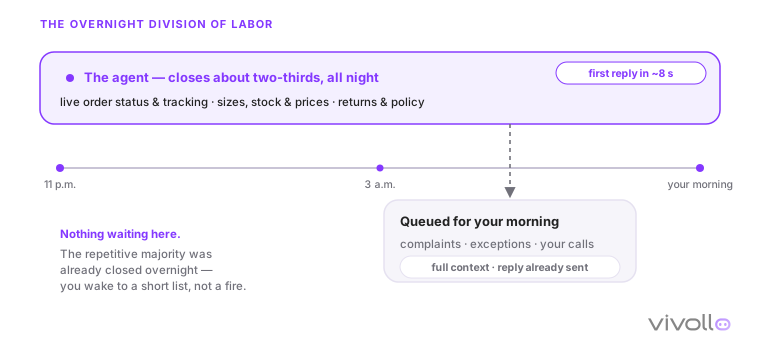
About two-thirds of it, when it's connected properly. Across our deployments, 66–72% of conversations end without a human, and the overnight mix — orders, sizes, stock, policies — is precisely the repetitive, answerable majority that number is made of. The first reply lands in about 8 seconds, which at 3 a.m. is the difference between an answer and an apology.
Concretely, the agent closes these alone:
- Live order lookups — status and the real tracking link, read from your store's data, not a canned "we'll check in the morning."
- Sizes, stock and prices from the live catalog, so the answer reflects what's actually on the shelf right now.
- Returns and the policy long tail, answered from your own pages instead of from guesses.
İnce Topuk, a fashion e-commerce store, resolves 66% of its WhatsApp conversations exactly this way — sizes, stock, prices, order status — without staffing a single night hour. (If WhatsApp is your main channel, our WhatsApp-for-Shopify guide covers the setup end to end.)
One platform rule quietly works in your favor here. WhatsApp's 24-hour customer service window opens the moment a customer messages you — so a 3 a.m. question is exactly when you're free to reply, if anything is awake to do it. An agent uses that window while the intent is fresh; a morning-shift human catches its tail end.
The two-thirds isn't automatic, though. The gap between a 40% deployment and a 70% one is almost never the AI model — it's whether the agent can read your actual catalog and policies. Before committing, it's worth understanding what drives the resolution rate, because an agent fails at night the same way it fails at noon: it can't answer what it was never given.
What waits for morning — and how it waits
The honest part: roughly a third of conversations should not be closed by an AI, and the clock doesn't change that. The complaint that's really about something else, the wholesale negotiation, the loyal customer who deserves a goodwill gesture — an agent that improvises on these does damage at any hour. Overnight, those conversations queue. That's the trade, stated plainly.
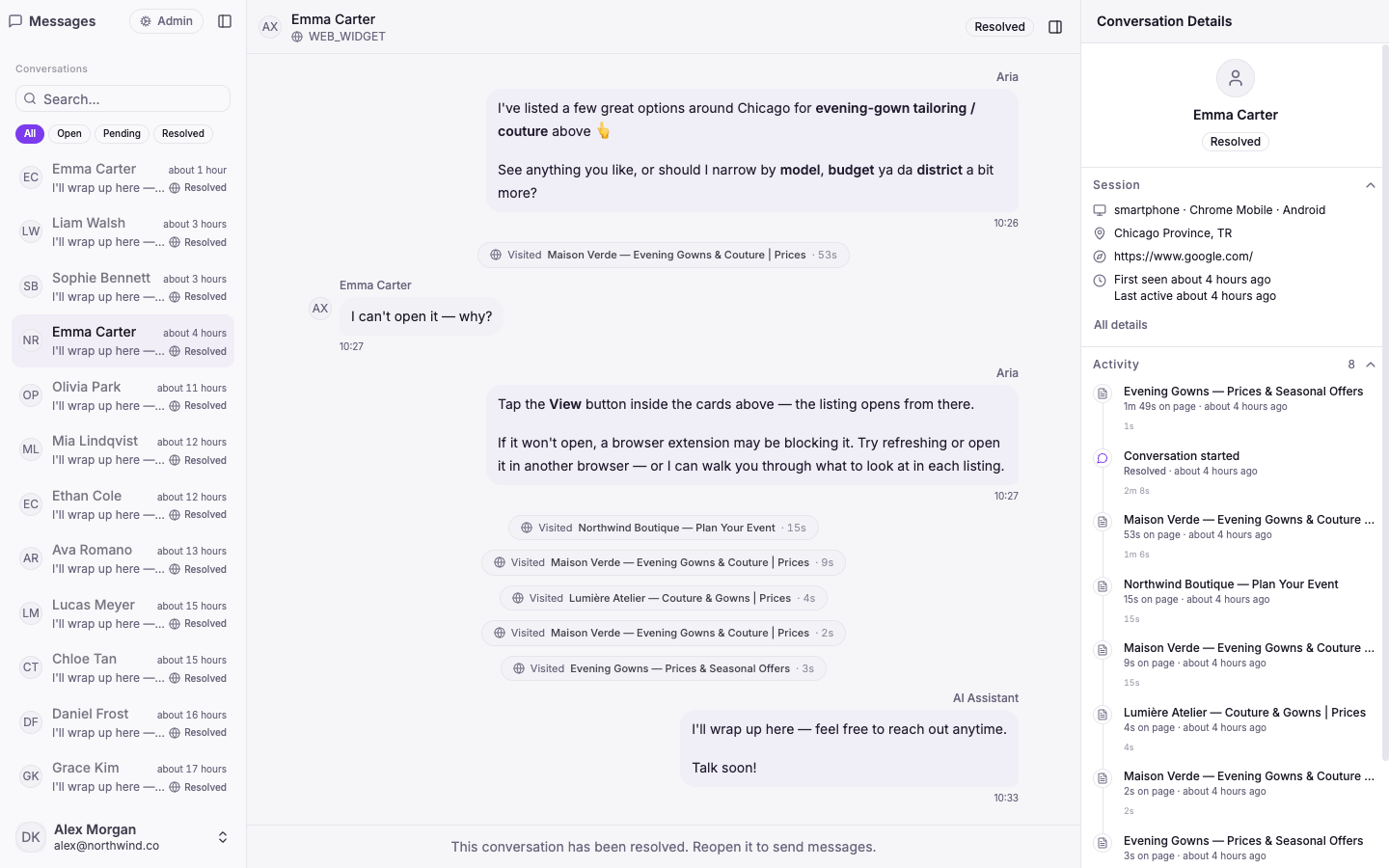
What a good setup changes is how they queue. The conversation moves to the human inbox with everything attached — the full thread, the customer's history and memory, their journey across channels — and the customer isn't staring at an unread DM: they got a first reply in seconds and know a person will follow up. Your morning stops being an excavation. Instead of reconstructing six conversations from fragments, you triage a short, pre-worked list over coffee — read, decide, reply — and the agent picks the conversation back up once you've handled the part that needed you.
That queue doesn't design itself. Which cases escalate, what the customer is told at 3 a.m., how automation resumes after you step back out — we've written up how to design the AI-to-human handoff as its own guide, because it's the piece that decides whether your morning list feels like leverage or like a second inbox.
The time-zone and language multiplier
"After hours" quietly assumes everyone shares your clock. Sell across borders and someone's shopping afternoon is your 2 a.m. — which turns coverage from an eight-hour gap into a rota problem no team of one to five can staff: nights, times weekends, times languages. The multiplication defeats you before the salaries do.
Turna, a travel and ticketing platform, runs exactly that surface — changes, refunds and ticket rules, across languages, around the clock — and resolves 72% of conversations end-to-end without a human. No plausible human rota produces that coverage.
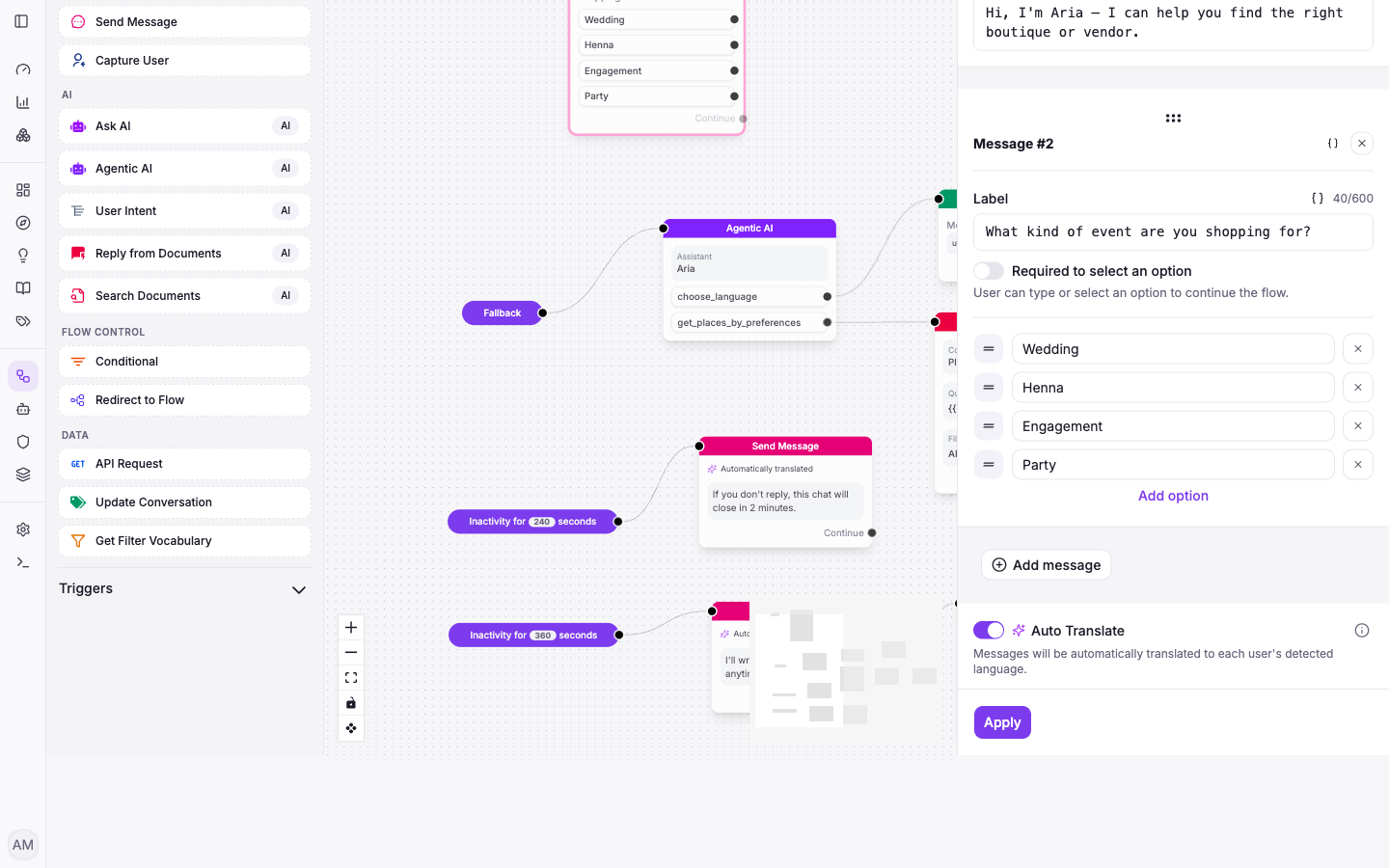
The language half doesn't require parallel flows, either. Live Translate is a toggle on any send-message step: the agent detects the visitor's language from their messages and translates its replies automatically. You author the flow once, in your own language, and the same flow serves every market you ship to — no per-language night staff, no five copies of the same automation drifting apart.
The model here is the one from our broader guide to AI customer service for a small business, applied to the clock: agent on the front line, you as the backup — except at night the backup is asleep, and should be. The agent closes the repetitive two-thirds with an ~8-second first reply; the exceptional third waits for you, pre-worked and in context, not as a pile of unread DMs. If you want to see that front-line-plus-morning-queue model working in a real inbox, that's precisely what our support solution is built around.
Common questions
- Do I need to hire a night shift for customer support?
For an online store, almost certainly not. Overnight questions are mostly repetitive and transactional — order status, sizes, stock, policies — and an AI agent resolves that majority alone (66–72% of conversations in our deployments, with a first reply in about 8 seconds). The judgment calls queue for your morning with full context.
- What happens to complicated questions at 3am?
They wait for you — but they wait well. The conversation moves to the human inbox with the full thread, customer history and journey attached, and the customer has already received a first reply in seconds. You triage a short, pre-worked list in the morning instead of reconstructing conversations. How to design that queue is its own craft.
- Does it work if my customers write in different languages?
Yes. Live Translate is a toggle on any send-message step: the agent detects the visitor's language from their messages and translates replies automatically. You author the flow once in your own language, and one flow serves every market you sell to.
- Which channels does after-hours coverage include?
The ones an online store's customers actually use at night — WhatsApp, Instagram DMs and comments, Messenger, and an embeddable web widget — in one unified inbox, so context follows the customer across channels instead of fragmenting into four apps.
About the author

Bilgehan YılmazCo-Founder · Growth & CX
Co-founder of Vivollo and a serial entrepreneur on the growth and customer-experience side — also founder of DüğünBuketi.com and Grispi. He writes about turning support conversations into revenue.
Bilgehan Yılmaz →Keep reading
AI customer service for small business: what AI handles, what you keep
An AI agent resolves 66–72% of a small store's conversations — orders, sizes, returns — so a team of 1–5 covers the rest. What works, and how to start.
Instagram DM automation for e-commerce: turn DMs into sales
Most DM bots deflect. An agent that qualifies converts — one store turns 38% of chats into qualified leads. Here's the flow, and Meta's rules that gate it.
Intercom Fin alternative for small business (2026)
Fin is capable — but per-resolution pricing means you pay more as it works better. When that math turns against a small store, and what to look for instead.