
Agentic AI vs rule-based chatbots: what actually changes
Rule-based bots match keywords and route to a human. Agentic AI calls tools and finishes the job — here's where the difference shows up, and where it doesn't.

The short version: a rule-based chatbot matches keywords and follows a script — when the conversation goes off that script, it apologizes and fetches a human. An agentic AI reasons over context, calls real tools, and carries the task to completion. Ask both "where's my order #10482?" and only one of them actually looks up the order.
That single capability — doing things, not just talking — is what separates a bot that deflects the easy 20% from an agent that resolves 66–72% of conversations. But "agentic" is also the most abused word in support software right now, so here's what the difference really is, where it shows up, and where it genuinely doesn't matter.
What a rule-based chatbot actually is
A rule-based chatbot is a decision tree wearing a chat bubble. You define the paths — keywords, buttons, branches — and it walks the customer down whichever branch matches. Within its script it's fast and predictable.
Its ceiling is also its design. It can only handle what you anticipated and built:
- A question phrased a way you didn't script → "Sorry, I didn't understand that."
- Anything transactional ("change my address") → routed to a human, because the bot can't do it.
- A follow-up that assumes memory → it starts over.
So a rule-based bot's resolution rate is capped at the share of questions that are both repetitive and purely informational. For most stores that's a minority of the inbox.
What "agentic" actually means
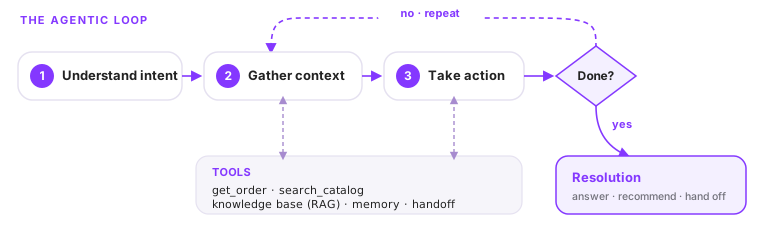
An agentic AI isn't "a smarter chatbot" — it's a different machine. Instead of walking a fixed tree, it runs a loop: understand intent → gather context → take action. The "gather context" and "take action" steps are where the tools come in — and tools are the whole point.
A real agent can:
- Call your systems — look up a live order, check stock, start a return
(
get_order,search_catalog, and the like) — the same tools behind AI support on a WooCommerce store. - Retrieve your truth — answer from your own catalog, docs and policies via retrieval over a knowledge base, instead of guessing. How you shape that content for retrieval decides whether it works.
- Remember the customer — carry context across the conversation and prior ones.
- Hand off cleanly — escalate to a person with the full history when the job needs judgment.
Define it precisely, because vendors won't: agentic = an LLM that chooses and calls tools in a loop to complete a task. A model that only generates text — a "GPT wrapper" with no tools — is still just a talking bot, however fluent.
Where the difference shows up
Same six situations, two very different outcomes:
| Situation | Rule-based chatbot | Agentic AI |
|---|---|---|
| "Where's my order?" | "Check your email for tracking" — or routes to a human | Looks up the order, replies with live status + tracking |
| A question you didn't script | "I didn't understand that" → human | Reasons from your docs and answers, or asks one clarifying question |
| Multi-step task (find → reserve → checkout) | One button per branch; breaks off-path | Chains tools in a single conversation |
| Customer writes in another language | A separate flow per language | Detects the language and replies natively |
| "This is the third time I've asked" | No memory — starts over | Recalls the customer and the prior thread |
| When it doesn't know the answer | Guesses down the tree or dead-ends | Hands off to a human with full context |
Notice the pattern: the rule-based column is full of dead ends and humans. The agentic column finishes. That's the difference your resolution rate feels.
Why this changes the economics, not just the UX
Because an agent can take action, it resolves the transactional questions a scripted bot has to escalate — "where's my order," "swap the size," "start a return." Those are the bulk of an e-commerce inbox, and moving them from "route to a human" to "resolved in the chat" is the core of AI customer service for a small business. It lifts real auto-resolution into the 60–75% range, lets the same WhatsApp conversation that answers a question also close a sale, and turns an Instagram DM into a qualified lead rather than a deflected one.
A rule-based bot deflects tickets. An agent resolves them — and occasionally earns revenue doing it. Different category, different math.
"Agentic" is not automatically better
The honest part most vendors skip: an agent is only as good as what you give it, and a bad one fails louder than a scripted bot.
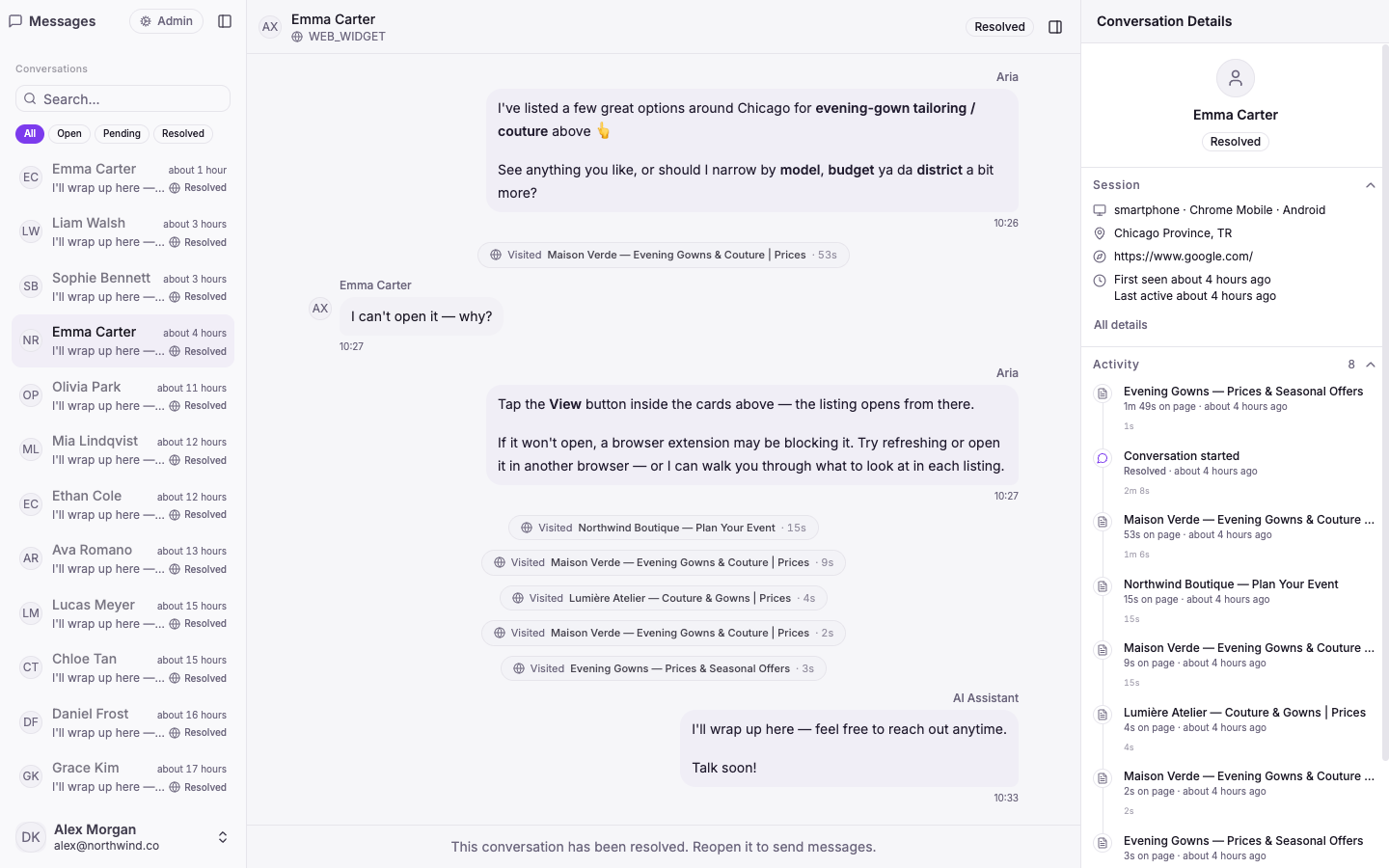
- Ungrounded, it hallucinates. An agent with no retrieval over your real content will confidently invent a return policy. Grounding (RAG) and guardrails aren't optional extras — they're what makes the autonomy safe.
- Without a designed handoff, it overreaches. The goal isn't 100% automation; it's automating the repetitive majority and routing judgment calls fast. A clean handoff to a human raises your effective resolution rate.
- For trivial, fully-scripted flows, a tree is fine. A two-step lead form doesn't need an agent. Use the simpler tool when the job is genuinely fixed.
Agentic wins when reality is open-ended and the answers live in your systems — which, for support and e-commerce, is most of the time. It's overkill for a fixed-path form.
How to tell which one you're actually being sold
"AI" and "agentic" are on every vendor's homepage now. Four questions cut through it:
- Can it call my systems? Ask for a live order lookup or a stock check in a demo. If it can only read a static FAQ, it's a scripted bot with better autocomplete.
- Can it answer something you didn't script? Throw it an oddly-phrased, real question. Watch whether it reasons or falls back.
- Where do its answers come from? A real agent cites your content; a bot recites canned text or guesses from general training.
- What happens when it's unsure? A good agent hands off with context. A bad one guesses. A scripted one dead-ends.
If the demo dodges the first question, you have your answer. If you're comparing tools rather than concepts, our buyer's guide to AI support software covers what to check, and we work the per-resolution pricing math behind an Intercom Fin alternative for a small store. And if a lighter inbox is the real goal, agentic resolution is one lever — reducing the tickets that arrive is the other.
Want to see an agent actually take an action rather than describe one? Watch how Vivollo looks up an order, searches the catalog and updates it inside a single conversation — then hands off only when it should.
Common questions
- Is agentic AI just a chatbot with GPT bolted on?
No. A language model alone still only talks. What makes it agentic is tool-calling — the ability to look up an order, search your catalog, read your docs and act — plus the loop that decides which tool to use. A GPT wrapper with no tools is still a talking bot.
- Are rule-based chatbots obsolete?
Not for everything. For a fixed, fully-scripted flow with a handful of outcomes — a lead-capture form, a simple booking — a decision tree is cheap, predictable and fine. They break when reality goes off-script.
- Does agentic AI hallucinate more?
It can if it's ungrounded. An agent that retrieves answers from your own catalog and docs (RAG) and has guardrails hallucinates far less than one guessing from general training. Grounding is what makes it trustworthy.
- Can I move from a rule-based bot to an agentic one?
Yes, and you usually keep the parts that work. Deterministic flows still handle scripted steps; the agent takes over the open-ended questions and the system lookups the tree never could.
About the author

Davut KemberCo-Founder & Full-Stack Developer
Co-founder of Vivollo, building the agentic support platform end to end. He writes about the engineering reality of AI agents that take real actions — and what actually moves resolution rates and reply times.
Davut Kember →Keep reading
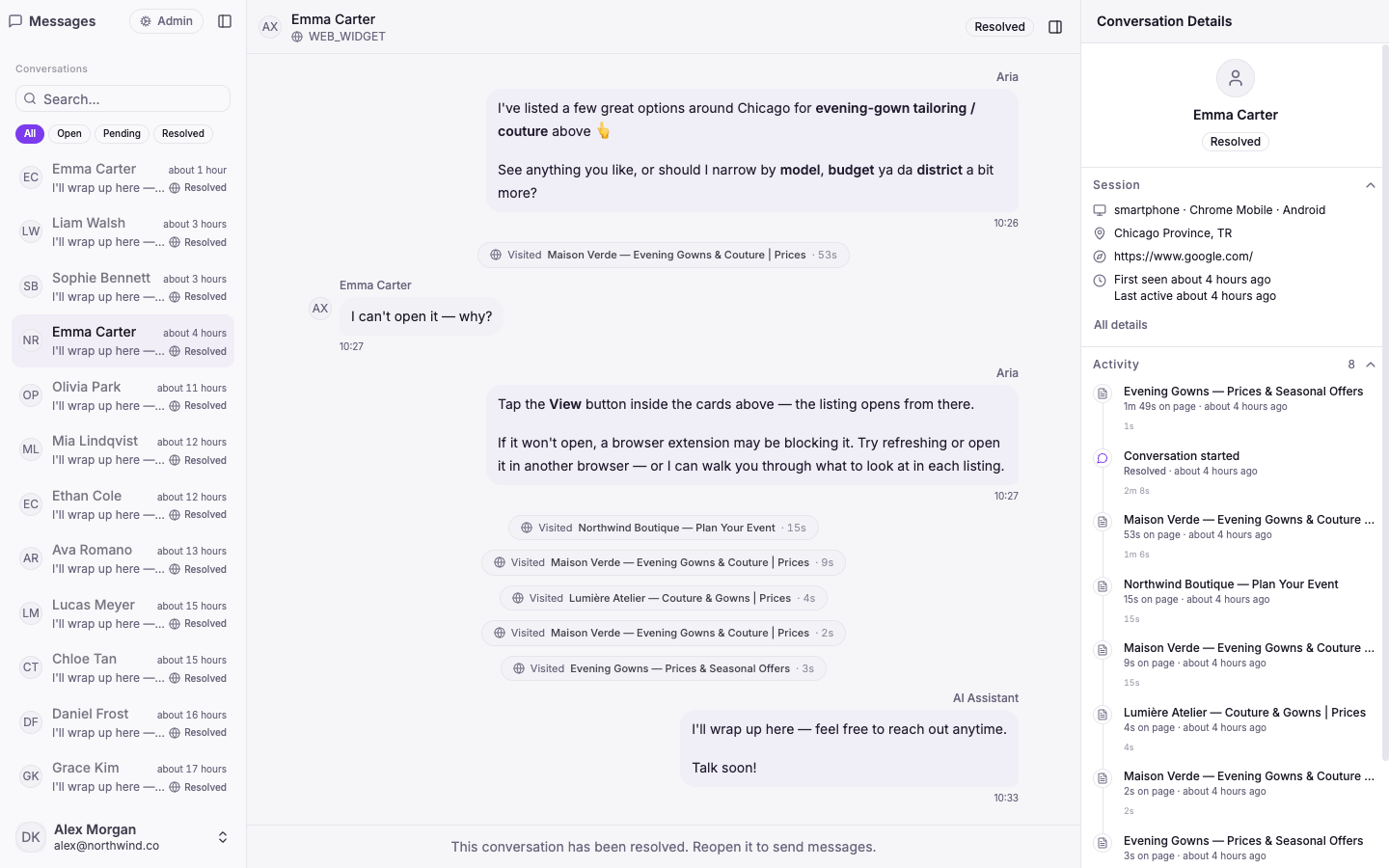
AI-to-human handoff: design it so nobody repeats themselves
AI resolves 66–72% of conversations in our deployments — handoff governs the rest. What triggers it, what context travels, and what happens after.
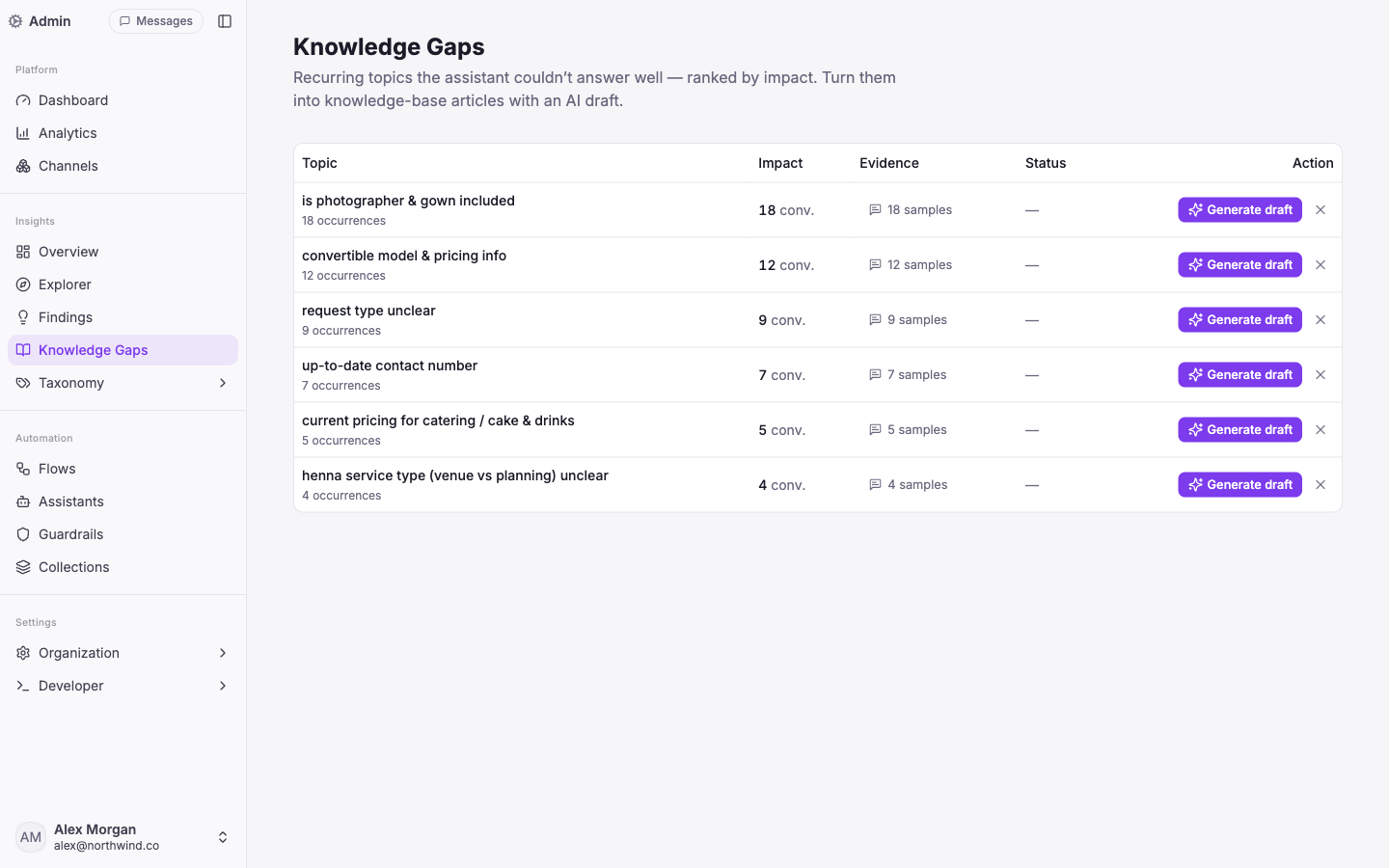
Why your AI chatbot can't answer — and how to fix it
The AI that resolves 66–72% of conversations isn't smarter than your bot — it's better informed. Most "dumb bot" failures are knowledge gaps, and they're fixable.
How much customer support can AI actually resolve?
Most published auto-resolution rates are inflated by how "resolved" is counted. Here's an honest framework — and the 66–72% we see in real deployments.