
Why your AI chatbot can't answer — and how to fix it
The AI that resolves 66–72% of conversations isn't smarter than your bot — it's better informed. Most "dumb bot" failures are knowledge gaps, and they're fixable.

Your chatbot isn't dumb — it's uninformed. The agents that resolve 66–72% of conversations without a human in our deployments run on the same class of language models as the bot that keeps apologizing. What separates them is almost never intelligence. In our deployments, the resolution rate is driven mostly by two things: whether the answer exists somewhere the AI can read, and which systems the AI can act on. Everything else — the model, the prompt, the personality — moves the number far less.
That's better news than it sounds. You can't make a model smarter this week. You can absolutely fix what it knows.
Why your AI chatbot can't answer questions
Nearly every "I don't know" traces back to one of three gaps — and none of them lives in the model.
1. The answer was never written down. The return-window exception for sale items, whether the blue colorway runs small, what happens when a customer misses a delivery — the answer exists, but only in your head or in a senior agent's memory. No retrieval system can surface a sentence that was never written. This is the most common gap by far, and the least visible from inside the business, where everything feels documented because you know it.
2. The answer is written, but the AI can't read it. A sizing chart inside a supplier PDF, a shipping policy on a page nobody pointed the bot at, three years of resolved tickets that between them answer almost everything. The knowledge exists in writing — it's just locked in formats and places no one connected. Getting it into a shape an agent can actually retrieve is its own craft — we walk through it in rewriting your help center for AI.
3. The answer isn't a document at all. "Where's my order?" has no correct written answer — it's a live database row that changes hourly. So are stock, delivery ETAs and refund status. No knowledge base fixes these; the AI needs to query the system that holds the answer. A bot that can only chat fails here by design, however good its documents are.
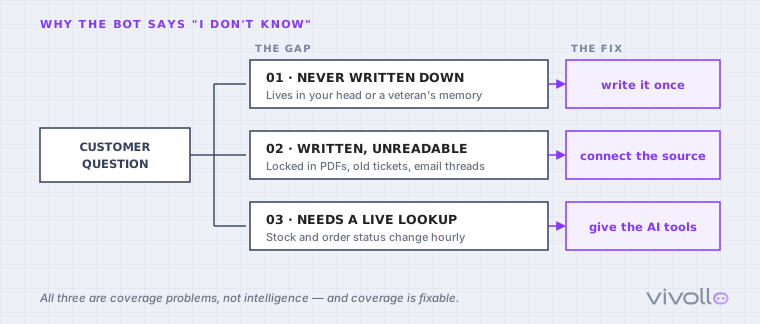
Notice what's missing from that list: model quality. Upgrading to a "smarter" AI while the answer stays unwritten buys you more fluent apologies.
How to find your bot's blind spots
You don't have to guess — your bot already produces a complete list of its own failures. Every question it couldn't answer is logged somewhere; the problem is that nobody reads raw logs. So we turned the log into a report.
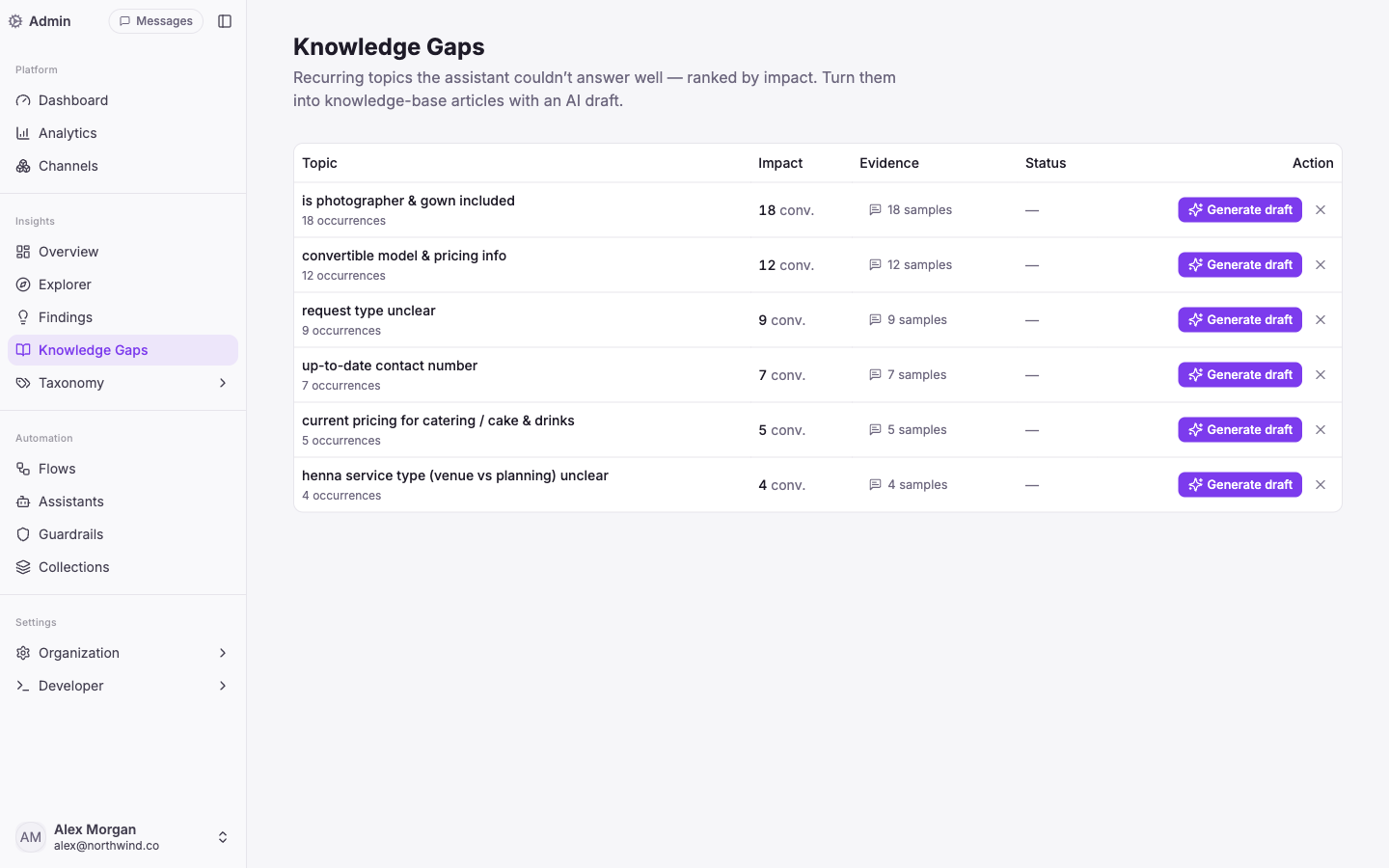
The Knowledge Gaps report — part of Conversation Intelligence — groups recurring unanswered topics and ranks them by impact: how often each one comes up and how many conversations it derails. Instead of "write more FAQs," you get "these nine topics caused most of your handoffs this month, in this order."
Then the loop closes. One click drafts a knowledge-base article for the gap — grounded in the real customer conversations that exposed it, enriched with a web search where public facts help, and run through a formatting pass so it reads like documentation rather than a transcript. You review it, edit it, publish it — or dismiss the topic if it isn't worth answering. Once published, the question that failed last week resolves on its own next week.
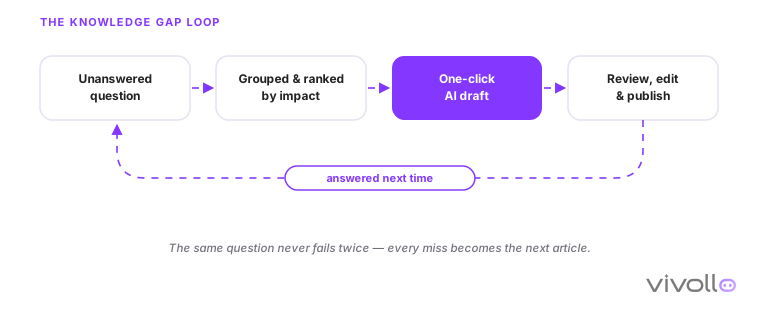
The loop pays twice. Failures pile up fastest where nobody is watching — overnight and on weekends — so the report doubles as a free audit of your after-hours coverage. And every article it produces also feeds your public help content, which cuts tickets at the source, not just in the chat.
Make your existing knowledge readable first
Before writing anything new, connect what you already have — most businesses sit on more documented knowledge than their bot can see. The sources worth wiring in, roughly in order of effort-to-payoff:
- Your website — scanned from the sitemap or page by page, with JavaScript rendering so single-page storefronts don't come back empty.
- Help desks and CMSs — Zendesk help-center articles, WordPress content.
- Files — PDFs, plain text, markdown. The supplier size chart finally becomes readable.
- Manual entries and API — for the answers that were living in your head, straight out of the gap loop above.
- Your commerce catalog — Shopify, WooCommerce, Ticimax and Trendyol products plus their Q&A, so "does it run small?" meets actual product data.
This is what our Knowledge Engine connects out of the box, and it keeps itself current with scheduled re-crawls and change detection — so a price update on your site doesn't leave the bot quoting last month.
How the AI searches that pile matters as much as what's in it. In one sentence: hybrid retrieval pairs semantic (vector) matching with exact keyword (BM25) matching, so "SKU TX-410" and "that red shirt in medium" both land on the same product. This is retrieval-augmented generation, and the original RAG research found that grounded models produce measurably more specific, factual answers than models relying on training memory alone — the polite way of saying ungrounded bots make things up.
The honest limit: knowledge fixes the informational share
A perfect knowledge base still won't get you to 100% — and anyone promising it will is counting loosely. Knowledge coverage fixes the questions whose answer is a fact: policies, sizing, compatibility, how-tos. Two categories remain, and they need different machinery:
- Transactional questions need action, not documents. "Change my delivery address" is resolved by an agent that can call your systems, not by an article about addresses.
- Judgment calls need a human. The third-time complaint, the refund exception, the angry VIP — these should reach your team fast and with full context, through a deliberately designed handoff, not after the bot has exhausted the customer's patience.
Get all three right — knowledge for the informational share, tools for the transactional, handoff for judgment — and you land in the 66–72% we see in production, with a median first reply around 8 seconds. That combination is the whole playbook of AI customer service for a small business; knowledge coverage is the piece most teams underestimate.
If your bot keeps saying it doesn't know, don't shop for a smarter bot yet. Connect what you already have — site, help docs, catalog — and let a week of real conversations write your to-do list. The gaps report will be more specific than any audit you could commission.
Common questions
- Why does my AI chatbot give wrong answers?
Usually because it's guessing. An AI with no access to your real policies, catalog and docs answers from general training — fluently and wrongly. Ground it in your own content and have it hand off when nothing matches, and wrong answers turn into honest ones.
- How do I train an AI chatbot on my own data?
You don't retrain the model — you connect sources it can retrieve from: your website, help center, PDFs and product catalog. A knowledge engine ingests these directly and keeps them fresh with scheduled re-crawls, no ML work required.
- Will adding more FAQs improve my chatbot?
Only the right ones. Articles nobody asks about are wasted effort. Start from the questions your bot actually failed to answer, ranked by how often they recur — that list, not a brainstorm, is your writing queue.
About the author

Davut KemberCo-Founder & Full-Stack Developer
Co-founder of Vivollo, building the agentic support platform end to end. He writes about the engineering reality of AI agents that take real actions — and what actually moves resolution rates and reply times.
Davut Kember →Keep reading
AI-to-human handoff: design it so nobody repeats themselves
AI resolves 66–72% of conversations in our deployments — handoff governs the rest. What triggers it, what context travels, and what happens after.
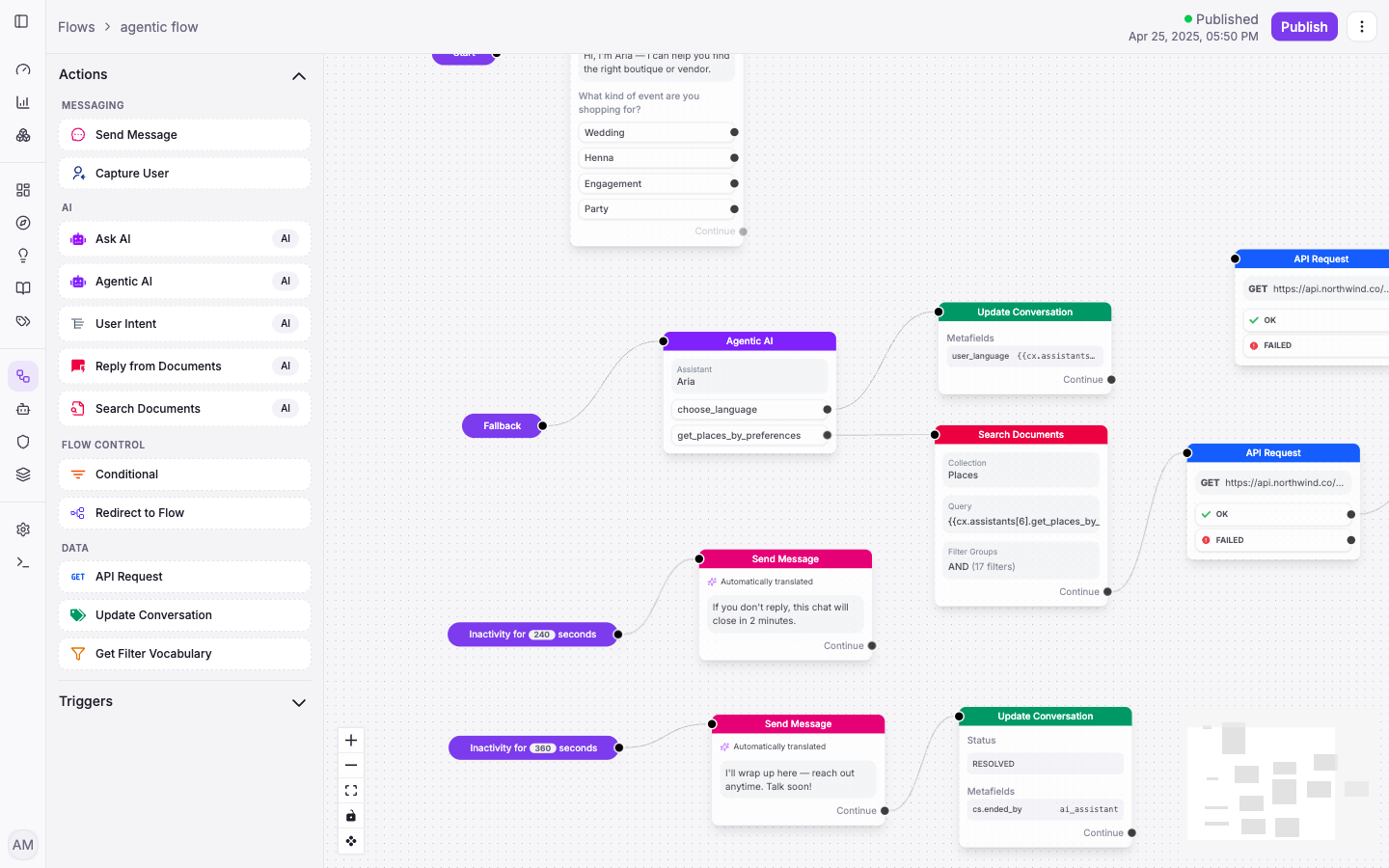
Agentic AI vs rule-based chatbots: what actually changes
Rule-based bots match keywords and route to a human. Agentic AI calls tools and finishes the job — here's where the difference shows up, and where it doesn't.
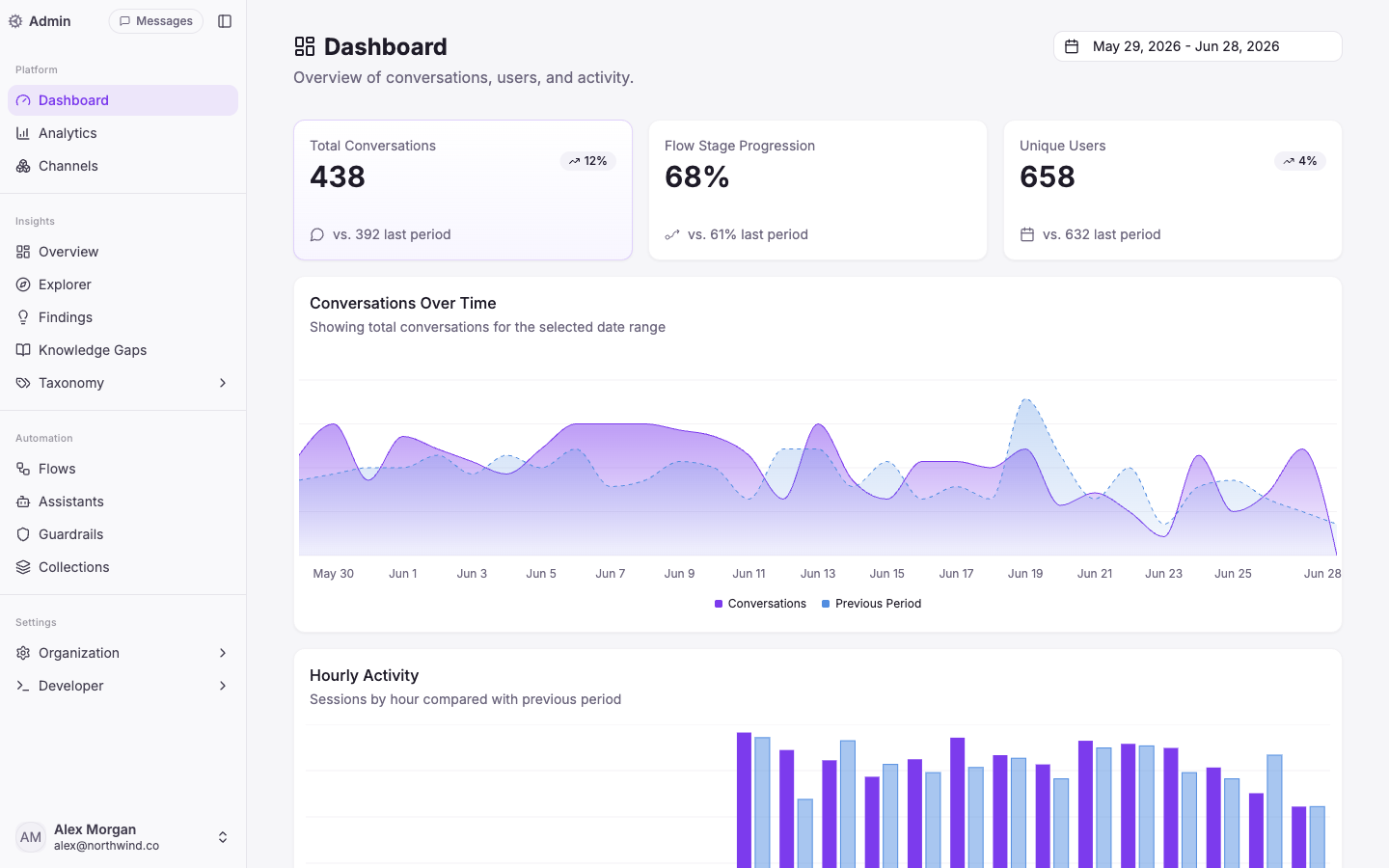
How much customer support can AI actually resolve?
Most published auto-resolution rates are inflated by how "resolved" is counted. Here's an honest framework — and the 66–72% we see in real deployments.