
Best AI customer support software for small business (2026)
An honest buyer's guide: why the resolution-rate leaderboards mislead, what to check on pricing, and how a small store should actually choose.

There is no single "best AI customer support software for small business" — and any list that hands you a ranked top 10 is quietly skipping the part that matters. The right tool depends on your store, your channels, and your volume — if you're still deciding whether to use AI at all, start with AI customer service for a small business. Worse, most of those lists rank by a "resolution rate" number that the vendors themselves admit is gameable.
So instead of a leaderboard, here's how a small store should actually choose: why the headline numbers mislead, what to read on the pricing page, and the five questions that decide it.
Why the resolution-rate leaderboards are mostly noise
The number everyone compares — "resolves 70% of tickets!" — isn't comparable across vendors, because each one counts it differently and reports its own. A 90%+ claim usually means forcing answers the tool shouldn't give.
Take the most transparent example. Intercom's Fin counts a "resolution" two ways: a confirmed resolution (the customer says the answer helped) and an assumed resolution — when the customer simply stops replying for about 24 hours after the bot's last message (per Intercom's own outcomes docs). A customer who gave up, got distracted, or rage-quit is counted — and billed — the same as one who was genuinely helped.
And it's not just the counting. Intercom's own co-founder, Des Traynor, said the quiet part out loud about cross-vendor numbers:
"we too can selectively sample certain customers or certain verticals and give you a far higher number." — Intercom, on Fin 2
If the vendor with one of the more honest definitions is telling you the numbers are sample-able, treat every headline rate — ours included — as directional, not a promise. The only resolution rate that means anything is the one you measure on your own conversations.
Read the pricing model, not the sticker price
For a small store, how you're billed matters more than the monthly number, because the model decides whether your bill is predictable as you grow.
The common models:
- Per-resolution / per-outcome — you pay each time the AI resolves a chat. Intercom Fin is the clearest example: $0.99 per outcome, charged at most once per conversation, with a 50-outcome monthly minimum (~$49) (Intercom pricing, mid-2026 — re-check, this category changes pricing often). Aligns cost with value, but scales with your success, and — per the section above — can bill "assumed" resolutions you never confirmed.
- Per-seat — you pay per human agent. Predictable, but you're paying for people even as the AI does more of the work.
- Per-conversation / volume — you pay by chat volume regardless of outcome. Easy to forecast if your volume is steady.
- Flat tier — a fixed monthly price for a usage band. The most predictable, and often the friendliest to a small store that doesn't want a metered bill.
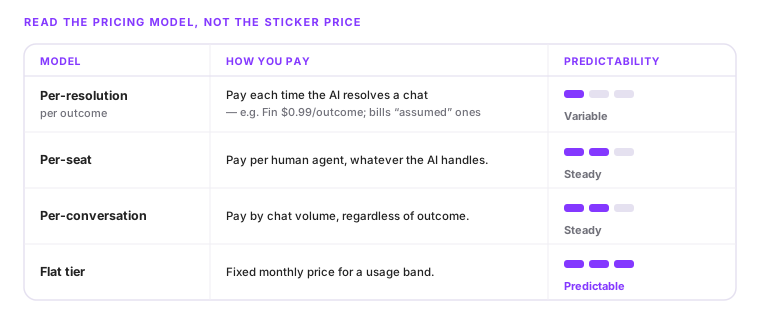
None is "best." But a per-resolution model that also counts assumed resolutions can surprise a growing store, so model your real volume against whichever you're quoted — and re-check the price at signup, because these change constantly. (If Intercom Fin is specifically on your shortlist, we work the per-resolution break-even math for a small store.)
The three kinds of tool you're actually choosing between
Forget the brand grid. For a small e-commerce store, almost every option falls into one of three archetypes — and the trap is buying from the wrong one.
1. Live-chat suites with an AI add-on. A familiar inbox/live-chat product with an AI layer bolted on. Cheap to start and easy, but the AI is often the shallow part — strong at answering FAQs, weaker at doing things like looking up an order or processing a return. Fine if your support is mostly informational.
2. Enterprise agentic platforms. Genuinely capable, deeply autonomous agents — built for large teams. The cost is the cost: sales-led "contact us" pricing, longer onboarding, and feature depth a small store will never use. Powerful, but the wrong weight class for five agents.
3. SMB-native agentic tools. The middle most small stores actually need: real tool-calling depth — order lookups, catalog search, returns — without enterprise pricing or a three-month rollout. This is where Vivollo sits, and it's the category the "top 10" lists tend to blur, because it's newer.
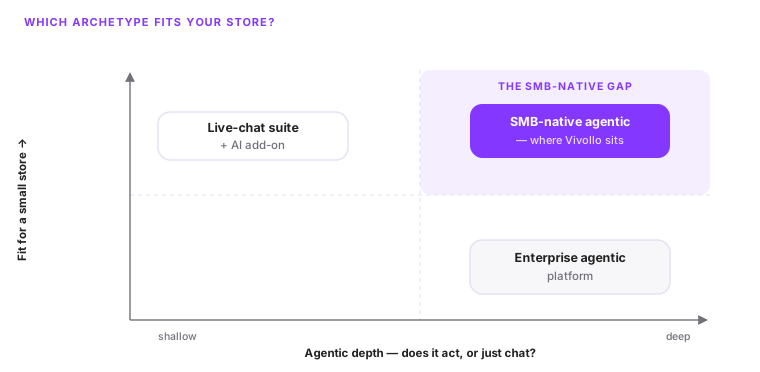
This is a map, not a ranking. The point isn't which logo wins; it's matching the archetype to your store before you compare features.
The five questions that actually decide it
For a small store, the choice comes down to five things — not a 40-row feature table:
- Does it act, or just answer? The single biggest divider. Can it look up a live order and update it, or only reply with text and route the rest to you? This is the agentic-vs-rule-based line, and it caps how much it can ever resolve.
- Does it plug into your store? Shopify or WooCommerce order lookups, returns and live catalog — or a generic web widget that knows nothing about your orders? For e-commerce this is the difference between resolving "where's my order?" and deflecting it.
- Where does it meet your customers? WhatsApp and Instagram where your shoppers actually are, or web-widget only?
- Is the price predictable at your volume? Run your real monthly conversation count through whichever model you're quoted — and check what counts as a billable resolution.
- How fast does it go live, and who builds it? A blank canvas you configure yourself, or a setup that's built for you in days.
How to actually evaluate — don't trust the demo number
The fastest way to cut through every vendor's marketing rate: run your own tiny benchmark.
Pull ten real questions from last month's inbox — a mix of "where's my order," a product question, a return, an oddly-phrased one — and give the same ten to each tool you're shortlisting. Then count confirmed resolutions yourself, the way we describe in how much support AI can honestly resolve. Ten real questions tell you more than any published percentage, because they're your questions.
If your store is past the FAQ-bot stage and you want an agent that actually looks up orders, searches your catalog and hands off cleanly — without enterprise pricing — that's the gap Vivollo is built for. See how it acts inside a single conversation, or start by auditing your own inbox before you talk to anyone.
Common questions
- Is there a single best AI customer support tool for small business?
No — it depends on your store. The honest axis isn't a leaderboard; it's whether the tool can act on your systems, plugs into your store, meets customers on your channels, prices predictably at your volume, and goes live fast. Pick on those, not on a headline number.
- How much does AI customer support cost for a small store?
It depends entirely on the pricing model. Per-resolution is common — for example, Intercom Fin is $0.99 per outcome with a 50-outcome monthly minimum (per Intercom's pricing, mid-2026; re-check, it changes). Watch that per-resolution models can bill "assumed" resolutions, and flat or per-conversation plans are more predictable as you grow.
- Are cheaper rule-based chatbots good enough?
For fixed, scripted flows — a lead form, simple routing — yes. For order lookups, returns and anything transactional, no: a rule-based bot can only route those to a human. That gap is the difference between agentic AI and a decision tree.
- How do I compare resolution rates between vendors?
Carefully, because you mostly can't. Every published rate is vendor self-reported and counted differently, and Intercom's own co-founder has said vendors can sample favourable customers to quote a higher number. Run your own test on your own inbox instead.
About the author

Bilgehan YılmazCo-Founder · Growth & CX
Co-founder of Vivollo and a serial entrepreneur on the growth and customer-experience side — also founder of DüğünBuketi.com and Grispi. He writes about turning support conversations into revenue.
Bilgehan Yılmaz →Keep reading
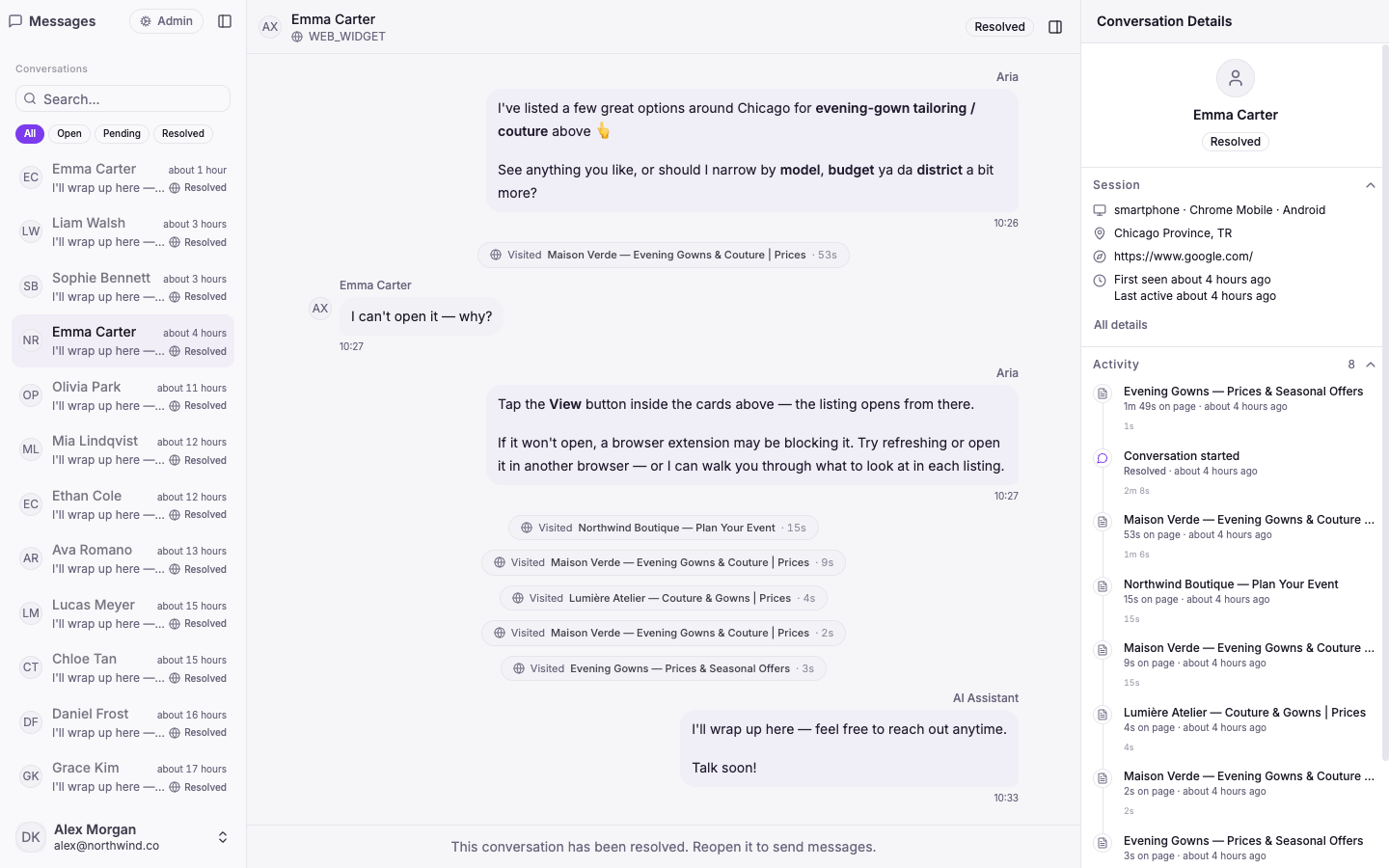
AI customer service for small business: what AI handles, what you keep
An AI agent resolves 66–72% of a small store's conversations — orders, sizes, returns — so a team of 1–5 covers the rest. What works, and how to start.
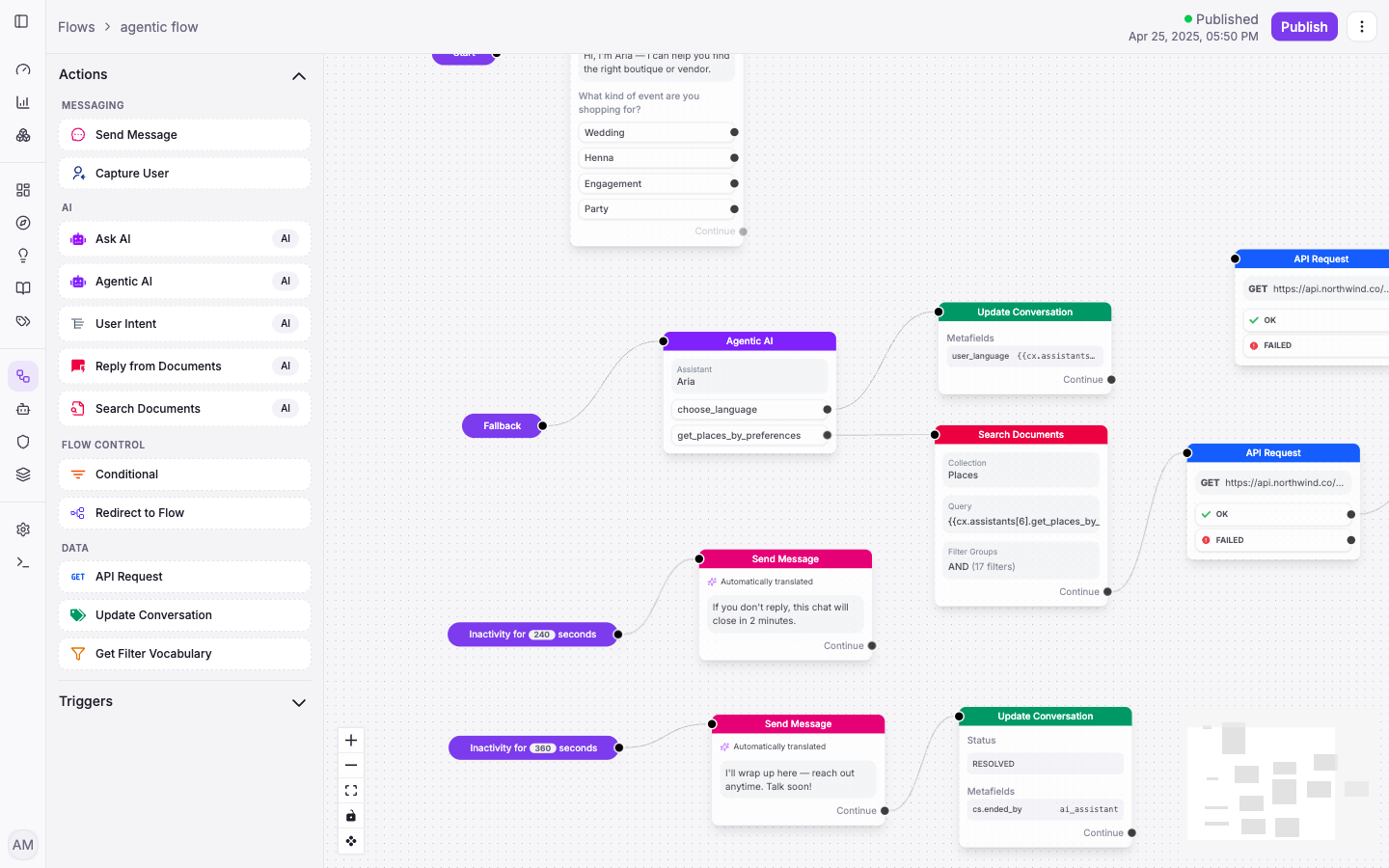
AI customer service for WooCommerce: what actually works
WooCommerce is self-hosted, so the win isn't the platform — it's connecting AI to your live orders and catalog. What an agent reads, writes, and resolves.
Intercom Fin alternative for small business (2026)
Fin is capable — but per-resolution pricing means you pay more as it works better. When that math turns against a small store, and what to look for instead.