
5 things AI customer support still can't do
Even the best AI resolves 66–72% of chats — so ~3 in 10 still reach a human. Five things AI support can't do, and why honest limits beat inflated vendor claims.

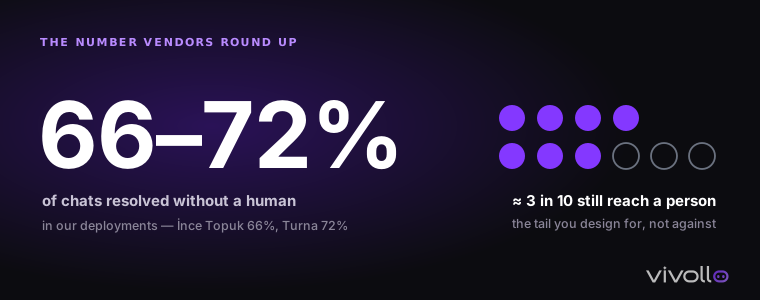
Every AI support vendor sells you the ceiling and hides the floor. So let's do the opposite. Even a well-built agent resolves 66–72% of conversations without a human — which means, honestly, that roughly three in ten still reach a person. That's not a flaw to paper over; it's the number that tells you whether a vendor is being straight with you.
We build one of these agents, and it acts on real orders — it doesn't just chat. That's exactly why we're clear about where it stops. Here are five things AI customer support genuinely can't do, why, and what a good tool does instead of pretending otherwise.
1. Change something irreversible without proving who's asking
An agent can look up an order in a second. What it shouldn't do is cancel that order, issue a refund, or change an account's details on the word of whoever is typing — because the person in the chat isn't always the account holder.
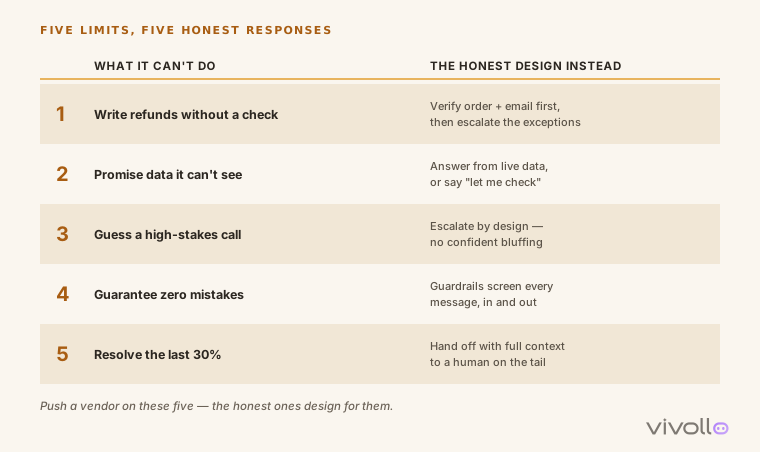
The honest design is a gate: before an agent triggers a refund or cancellation, it verifies identity — matching the order number to the email on file — and anything outside the rule (a refund exception, a dispute, a damaged item) routes to a human. An agent that will cheerfully refund anyone who asks isn't advanced; it's a liability. The line to look for is reads freely, writes carefully.
2. Promise anything it can't actually see
AI support can't quote a price, a stock level, or a delivery date that isn't in a system it can read. When it tries — when a bot "estimates" a delivery date to sound helpful — that's the failure mode that erodes trust fastest.
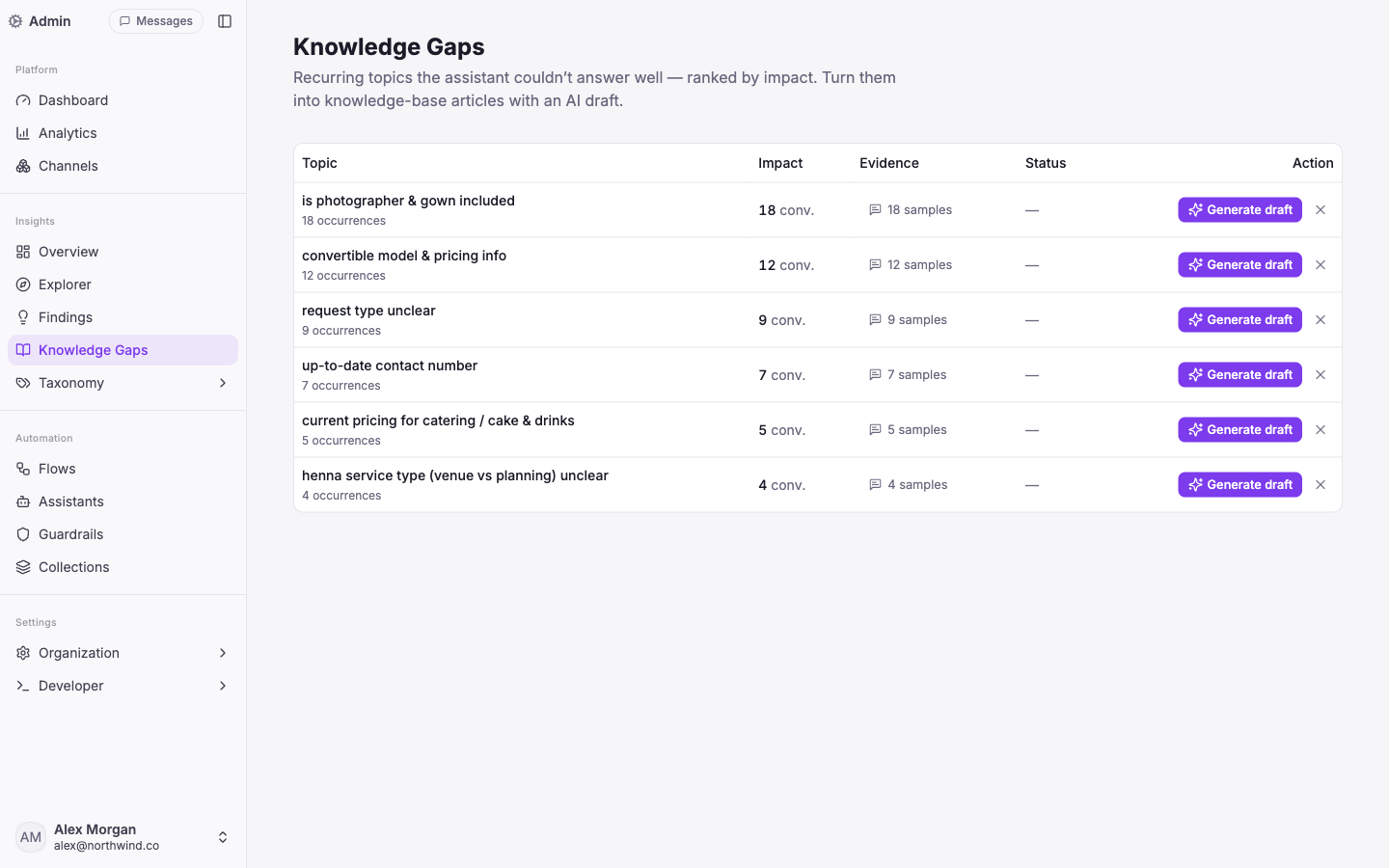
A grounded agent answers stock and price from your live catalog and order status from your live order data, and when the answer genuinely isn't knowable ("will this be back in my size next week?"), it says so and offers to check, rather than inventing a reassuring guess. Confident and wrong is worse than "let me find out." The fix isn't a smarter model — it's honest grounding and, when the answer doesn't exist yet, content the agent can actually read.
3. Guess its way through a high-stakes or technical decision
There's a class of question where a plausible-sounding wrong answer does real damage: an API integration detail, an account-security issue, a custom enterprise or pricing negotiation. Here, "the AI took a confident guess" is the outcome you least want.
A well-designed agent is instructed not to guess these — it escalates them by design. That's a feature, not a shortfall. The triggers that send a conversation to a human — uncertainty, high stakes, an explicit request, or a customer who's clearly upset — are the difference between a tool that knows its limits and one that bluffs past them and hopes.
4. Guarantee it will never say anything wrong
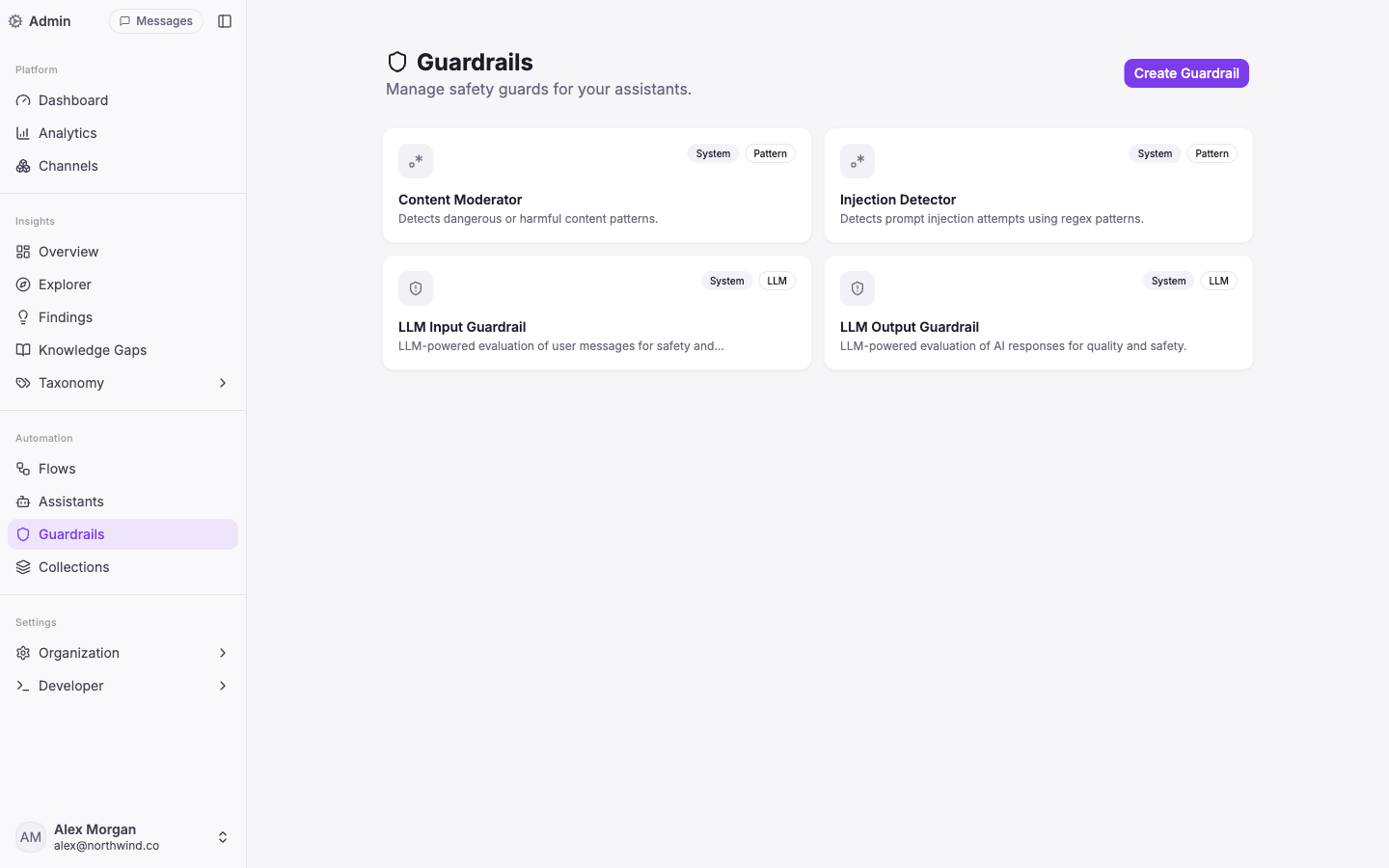
This is the one no honest vendor should promise: AI reduces hallucination, it doesn't eliminate it. Grounding the agent in your real content is what makes it answer from your store instead of its training data — but "sharply lower" is not "zero," and anyone claiming zero is selling.
What a serious tool adds is a second layer: guardrails that check every message, on the way in and on the way out, before it reaches the customer. In practice that means detecting and redacting the personal data customers paste into chat — emails, phone numbers, card details, national ID and IBAN numbers — so a secret never gets logged in the clear or echoed back, with the output buffered so nothing sensitive flashes on screen mid-reply. It's KVKK/GDPR hygiene, and it's the layer that assumes the model is fallible instead of pretending it isn't.
5. Resolve the last 30% — and it shouldn't try
The most important limit is the one vendors inflate hardest. When someone advertises a 90%+ resolution rate, one of two things is usually true: they're counting a customer who gave up as "resolved," or they're forcing the agent onto the judgment calls it should hand off — and paying for it in CSAT.
The honest ceiling we see in production is 66–72%, and the last chunk is supposed to reach a human: the emotional complaint, the wholesale negotiation, the one-off exception. For comparison, Intercom reports ~66% resolution for Fin — a vendor self-report with a much-debated methodology, which is exactly why you should ask how any number is measured. Counterintuitively, a clean handoff on that tail — carrying the full history, memory, customer identity, and the agent's written reason — raises your real resolution rate, because it stops the agent from breaking the cases it was never going to win.
Why the limits are the reason to trust it
None of this makes AI support a worse investment — it makes a well-built one easy to spot. The ~70% it resolves is the repetitive volume that used to eat your team's day; the value is a team of one to five covering what used to need ten, as we lay out in the guide to AI customer service for small business.
So when you're comparing tools, the honest ones will tell you where their agent stops — and design for it. Push a vendor on these five, and how they answer tells you more than any demo. The same questions run through our software-buying guide if you want a full checklist before you commit. A tool that admits what it can't do is usually the one you can trust with what it can.
Common questions
- Can AI customer support handle refunds and cancellations on its own?
It can start them, but it shouldn't complete an irreversible action without verifying identity — matching the order number to the email on file. Good agents gate refunds and cancellations behind that check and hand the exception to a person when anything looks off.
- Does AI eliminate wrong answers and hallucinations?
No — it reduces them. Grounding the agent in your real content and running guardrails on every reply cuts hallucination sharply, but no honest vendor claims zero. The goal is an agent that escalates when it isn't sure, not one that never errs.
- What resolution rate can I realistically expect?
In our deployments, 66–72% of conversations end without a human — which means three in ten still need one. A vendor promising 90%+ is either counting differently or forcing answers it shouldn't. See how much AI can resolve.
- If AI can't do everything, is it still worth it?
Yes — because the ~70% it handles is the repetitive volume that was eating your team's day. The value isn't full automation; it's a small team covering the work that used to need a large one, with the hard cases reaching them faster and with full context.
About the author

Bilgehan YılmazCo-Founder · Growth & CX
Co-founder of Vivollo and a serial entrepreneur on the growth and customer-experience side — also founder of DüğünBuketi.com and Grispi. He writes about turning support conversations into revenue.
Bilgehan Yılmaz →Keep reading
How to reduce support tickets without hurting CSAT
Cut the repetitive 60–75% of your inbox in three layers — prevent at the source, deflect with a real agent, route the rest in one touch — without the stalling that tanks CSAT.
AI-to-human handoff: design it so nobody repeats themselves
AI resolves 66–72% of conversations in our deployments — handoff governs the rest. What triggers it, what context travels, and what happens after.
Why your AI chatbot can't answer — and how to fix it
The AI that resolves 66–72% of conversations isn't smarter than your bot — it's better informed. Most "dumb bot" failures are knowledge gaps, and they're fixable.